DAILY NEWS

Stay Ahead, Stay Informed – Every Day

Advertisement
Under Trump, Chinese Firms Have Abandoned Billions in US Clean Energy Projects


Remember U.S. infrastructure? Something maybe about how bridges across America have been cracking and sometimes collapsing—or how our energy grid is an antiquated mess? Perhaps something about how the Biden administration passed a $891 billion spending package largely devoted to modernizing all the crumbling hardware undergirding the U.S. economy, making it safer, fortified against extreme weather, and less of a contributor of greenhouse gases? Well, sorry to say, the party’s over. In a sign of just how hostile the Trump administration has been toward its predecessor’s investment in a more sustainable and green economy, Chinese firms have scuttled an estimated $2.8 billion in planned U.S. energy projects over the past year. According to new research by analysts with the Rhodium Group, more than half of China’s proposed plans for clean-energy tech projects across the United States since 2022 have been either paused, delayed, or outright abandoned. “The policy environment is getting more restrictive,” as one former senior counselor to the Biden era’s Department of Commerce, Margaret Jackson, told Bloomberg.

Jackson, now a senior associate at the nonprofit Center for Strategic and International Studies, suspects that this inhospitable climate for green tech investing is unlikely to change even in the not uncommon scenario where Trump’s whims pivot in response to flattery.

“I’m not sure that below him there’s a lot of appetite to create space for more Chinese investment,” Jackson said. Not quite a solar-powered sunset Rhodium’s analysts reported that all three of the world’s leading regions for clean tech manufacturing, China, the U.S., and Europe, have pulled back on their commitments over the course of Trump’s first year back in office—but China’s behavior was unique. State intervention had once catapulted China’s domestic clean energy, battery, and electric vehicle manufacturing sectors five-fold from $37 billion in 2018 to a very sizable $189 billion in 2023, creating major market dominance in some areas (like solar) but also an overcapacity problem.

Nevertheless, even with a lower investment total and a flight from U.S. soil, China’s future plans for solar manufacturing infrastructure remain impressively monumental. Rhodium estimates that the nation has about 485 gigawatts of solar cell production capacity currently under construction domestically—or enough to power about 425 million additional Chinese homes a year—plus another 1.3 terawatts (1300 gigawatts) of solar capacity announced but not yet put in motion. If all goes as planned, China will literally still be doubling its solar power output, according to Rhodium. “The new policy focus on solar manufacturing and the EV supply chain is likely to emphasize maintaining China’s leading position and closing remaining technological gaps and overseas dependencies,” as the group’s report, published Wednesday, concluded. China’s U.S. solar sell-off The economic data reflects some more stark anecdotal news documenting how China-based firms have pulled up their solar stakes in communities across America. This month, for example, Chinese solar manufacturing giant JinkoSolar sold off 75.1% of its ownership stake in its U.S. subsidiary to a private equity firm, which will now run JinkoSolar’s 2-gigawatt (GW) solar panel production facility in Jacksonville, Florida.

China’s Trina Solar similarly pawned off a majority stake in its solar manufacturing facility to an American firm, T1 Energy, shortly after Trump won the White House in 2024. And Beijing-headquartered JA Solar also sold its own 2GW solar assembly plant in Arizona to Corning last July. Much of this skittishness ties directly to legal headaches from the Trump administration’s new Foreign Entity of Concern (FEOC) restrictions, introduced last year in that “Big, Beautiful Bill,” which places limits on the amount of Chinese ownership permitted for U.S. energy projects.

While industry analysts told Reuters that most Chinese manufacturers are clearly keeping low-level financial toeholds in their U.S. factories, the clear consequence is more price hikes and less clean energy across America for the foreseeable future as FEOC restrictions slow plans down. As Aaron Halimi, CEO of the San Francisco-based utility developer Renewable Properties, explained it to Reuters, “This is undoubtedly going to continue to increase the cost of power in the United States.”


Source link
How I Host My Side Projects for Under /Month (2026)


I run 4 live projects on a single VPS. Here’s exactly what I use and what it costs.

The Problem

You built an amazing side project. Now you need to deploy it.

Options:
→ Heroku: Free tier gone, cheapest $5+/mo per app 😬
→ Vercel: Great for frontend, limited backend ⚠️
→ AWS Free Tier: Complex, easy to overspend 💸
→ Shared hosting: Slow, outdated stacks 🐌

What I actually use for my projects:
→ 1 VPS + free tiers = everything running for ~$5/mo total 🎉

Enter fullscreen mode

Exit fullscreen mode

My Setup at a Glance

Project
Tech Stack
Hosting
Cost

AgentVote (main site)
Node.js + Nginx
VPS (port 3000)
Included

CryptoSignal
Node.js + SQLite
Same VPS (port 3001)
Included

Hugo Blog
Static HTML
Same VPS (Nginx)
Included

Text Formatter
Node.js
Same VPS (port 3099)
Included

Total: $5/month for the VPS. Everything else is free.

Option 1: VPS (What I Use)

Why a VPS?

✅ Full root access — install anything
✅ Run multiple projects on one server
✅ Fixed monthly cost regardless of traffic
✅ Learn DevOps skills that transfer to any job
✅ Complete control over your stack
❌ You manage security updates yourself
❌ No auto-scaling (but side projects don’t need it)

Enter fullscreen mode

Exit fullscreen mode

What to Look For

# Minimum specs for most side projects:
CPU: 1-2 cores
RAM: 1-2 GB (Node.js apps are light)
Storage: 25-50 GB SSD
Bandwidth: 1-2 TB/month (plenty for small projects)
OS: Ubuntu 22.04 or 24.04 LTS
Price: $3-6/month

Enter fullscreen mode

Exit fullscreen mode

VPS Providers I’ve Used

DigitalOcean — My Recommendation

Basic droplet: $4/month (512MB RAM, 1 vCPU)
Standard droplet: $6/month (1GB RAM, 1 vCPU)
Pros: Simple dashboard, great docs, massive tutorial library
Cons: No free tier
If you sign up through my referral link, you get $100 in credits over 60 days

Hetzner Cloud (Europe-based, excellent value)

CX22: €3.29/month (~$3.50) — 2 vCPU, 2GB RAM, 40GB SSD
Pros: Best price-to-performance ratio
Cons: Support is Germany-timezone

Vultr

Starting at $2.50/month (512MB RAM)
Many global locations
Good if you need servers close to your users

Linode (Akamai)

Starting at $5/month
Reliable, been around forever
Good documentation

My Nginx Config (Running 4 Apps on One Server)

# /etc/nginx/sites-available/myserver
# Each app on its own port, one domain

server {
listen 80;
server_name agentvote.cc;

# Main app
location / {
proxy_pass http://127.0.0.1:3000;
proxy_http_version 1.1;
proxy_set_header Upgrade $http_upgrade;
proxy_set_header Connection ‘upgrade’;
proxy_set_header Host $host;
}

# CryptoSignal sub-path
location /signal/ {
proxy_pass http://127.0.0.1:3001/;
proxy_set_header Host $host;
}

# Blog (static files)
location /blog {
alias /root/data/disk/projects/alexchen-blog/public;
index index.html;
try_files $uri $uri/ /blog/index.html =404;
}

# Text formatter tool
location /format {
return 301 /format/;
}
location /format/ {
proxy_pass http://127.0.0.1:3099/;
}
}

Enter fullscreen mode

Exit fullscreen mode

SSL with Let’s Encrypt (Free)

# Install certbot
apt install certbot python3-certbot-nginx -y

# Get certificate (free, auto-renews!)
certbot –nginx -d agentvote.cc -d blog.agentvote.cc

# Done! HTTPS enabled, auto-renewal before expiry

Enter fullscreen mode

Exit fullscreen mode

Process Management (Keep Apps Running)

# Option A: PM2 (simplest)
npm install -g pm2
pm2 start “node server.js” –name “app1”
pm2 start “node server.js” –name “signal”
pm2 startup # Auto-start on boot
pm2 save # Save process list

# Option B: systemd (no extra deps)
# /etc/systemd/system/app1.service
(Unit)
Description=App1
After=network.target

(Service)
Type=simple
User=root
WorkingDirectory=/root/data/disk/projects/app
ExecStart=/root/.nvm/current/bin/node server.js
Restart=always
RestartSec=10

(Install)
WantedBy=multi-user.target

systemctl enable app1 # Enable on boot
systemctl start app1 # Start now
journalctl -u app1 -f # View logs

Enter fullscreen mode

Exit fullscreen mode

Option 2: Free/PaaS Tiers (Great for Startups)

Vercel — Best for Frontend

Free: 100GB bandwidth, 100 serverless function invocations/day
Perfect for: React/Next.js/Vue/Svelte static sites & SSR
My blog’s frontend could run here free
Deploy: connect GitHub repo → auto-deploy on push

Railway — Easiest Backend Hosting

Free tier: $5 credit/month (enough for small hobby apps)
One-click deploy from GitHub
Auto-scales (but watch the costs!)
Great for: APIs, bots, background workers

Render — Heroku Alternative

Free tier: Web service (sleeps after 15min inactivity)
Databases: Free PostgreSQL (up to 90 days trial)
Great for: Quick prototypes, demos

Fly.io — Edge Deployment

Free allowance: 3 shared-cpu VMs × 256MB RAM
Deploy Docker containers globally
Great for: Low-latency global apps

Glitch — For Learning/Experiments

Completely free for public projects
Live editing in browser
Great for: Prototypes, learning, hackathon projects

Option 3: Hybrid Approach (Smartest)

Static sites → Vercel free tier (fast CDN, zero config)
API servers → Your VPS ($5/mo, full control)
Databases → SQLite on VPS (free) or Supabase free tier
Background jobs → Vercel Cron or your VPS
Files → Cloudflare R2 (S3-compatible, 10GB free)
Email → Resend (3000 emails/month free)

Result: Nearly free infrastructure that scales when needed.

Enter fullscreen mode

Exit fullscreen mode

My Monthly Cost Breakdown

Item
Cost
Notes

VPS (Hetzner/DigitalOcean)
$3.50-$5.00
Runs all my apps

Domain name (.cc)
~$8/year
~$0.67/month

Let’s Encrypt SSL
$0
Free, auto-renewing

Cloudflare DNS/CDN
$0
Free tier covers my needs

Total
~$5.67/month
For 4+ projects

How to Get Started (Step by Step)

Week 1: Get One App Running

1. Sign up for (DigitalOcean)(https://www.digitalocean.com/) (or Hetzner)
2. Create a droplet/server (Ubuntu 22.04, $4-6/mo plan)
3. SSH into your server
4. Install Node.js: curl -fsSL https://fnm.vercel.app | sh
5. Clone your project: git clone your-repo
6. npm install && npm run build
7. Start it: node server.js (or npm start)
8. Install Nginx: apt install nginx
9. Point domain to server IP
10. Set up SSL: certbot –nginx -d yourdomain.com

Enter fullscreen mode

Exit fullscreen mode

Week 2: Add Monitoring

# Uptime monitoring (free)
# UptimeRobot or Uptime.kuma (self-hosted)

# Error tracking
# Sentry (free tier for

# Log management
# journalctl -u your-app (built-in with systemd)
# Or Loki/Grafana (self-hosted free)

Enter fullscreen mode

Exit fullscreen mode

Week 3: Optimize

# Add rate limiting to Nginx
# Set up automated backups
# Configure log rotation
# Add health check endpoints
# Monitor resource usage

Enter fullscreen mode

Exit fullscreen mode

What About When You Scale?

Don’t optimize prematurely!

My rule of thumb:

Enter fullscreen mode

Exit fullscreen mode

What’s your current hosting setup? Are you overpaying?

Follow @armorbreak for more practical DevOps content.

Resources mentioned:


Source link

The 800ms Barrier: Architecting Interruptible Voice Agents (Lessons from Sarvam AI x Swiggy)


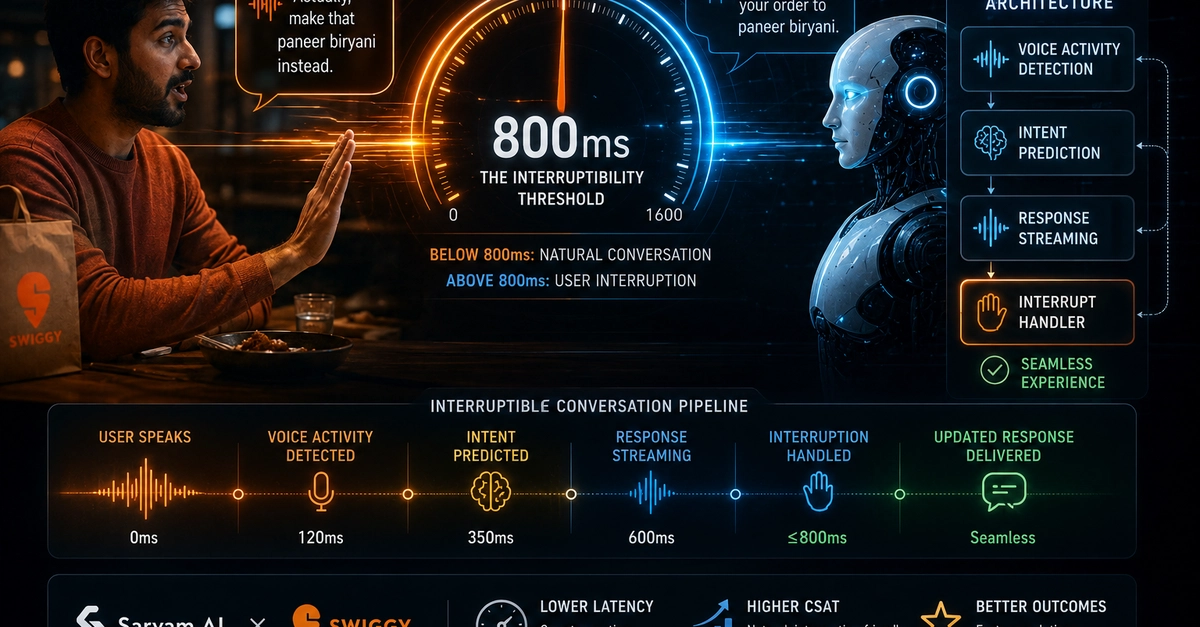
The 800ms Barrier: Architecting Interruptible Voice Agents (Lessons from Sarvam AI x Swiggy)The Signal: The 800ms Latency BarrierIn a research lab, a 3-second delay is an “optimization ticket.” In a live call with a hungry customer on the Swiggy app, 3 seconds is a churn event.

The partnership between Sarvam AI and Swiggy represents a shift in the “Boss Level” of agentic AI. Most developers build voice agents using a Cascaded Pipeline: STT -> LLM -> TTS. The result? A cumulative lag that makes the agent feel like a slow walkie-talkie. To build for the next billion users, you have to architect for Native Audio Streaming and sub-second response times.

Phase 1: The Architectural BetWe are moving from Request-Response to Streaming State Machines.

The Vendor Trap is relying on general-purpose, text-centric models for a multilingual, audio-first market. If you have to translate “Hinglish” to English just to understand an order, you’ve already lost the latency battle.

The Ownership Path is the Indic-Native Stack. Using Sarvam’s natively trained audio models allows us to process speech-to-intent directly. More importantly, we must implement a Bi-Directional WebSocket architecture. This allows the agent to “listen” while it “speaks”—the only way to handle the most difficult part of human conversation: The Barge-in.

Phase 2: Implementation (The Interruptible Voice Handler)In a high-stakes environment like Swiggy, the agent must be able to stop mid-sentence and roll back its logic if the user changes their mind.

// High-Level Logic for an Interruptible Voice Kernel
class VoiceAgentKernel {
constructor(wsConnection) {
this.ws = wsConnection;
this.isSpeaking = false;
this.transactionLock = null; // Ensuring tool-use safety
}

// Detecting the “Barge-in” (Interruption)
onUserSpeechDetected() {
if (this.isSpeaking) {
console.warn(“SIGNAL: Interruption detected. Executing State Rollback.”);
this.killAudioPlayback();
this.abortCurrentLLMGeneration();
this.clearPendingTransactions();
}
}

async handleAudioStream(chunk) {
// Stream raw audio to Sarvam’s native Indic-pipeline
const response = await this.ws.processAudio(chunk);

if (response.intent_confidence > 0.9) {
// Pre-warm tools before the user even stops talking
this.prepareOrderTransaction(response.entities);
}
}

clearPendingTransactions() {
// Essential: Prevents the “Ghost Order” bug
if (this.transactionLock) {
this.transactionLock.cancel();
this.transactionLock = null;
}
}
}

Enter fullscreen mode

Exit fullscreen mode

Phase 3: The Senior Security & Testing AuditI put this Swiggy-scale blueprint through a professional Senior QA & Security Audit. Here is why your “standard” voice agent will fail in the wild.

The “Ghost Order” Race Condition (Logic Fault)The Fault: The agent says “Ordering your Paneer Tikka…” The user interrupts: “No, wait! Make it a Chicken Roll!”The Audit: In naive implementations, the “Order Tool” is triggered the moment the LLM starts talking. If the user interrupts, the audio stops, but the backend API has already committed the Paneer Tikka. You now have a frustrated customer and a wasted order.The Fix: Implement Deferred Commits. The tool-call must remain in a PENDING state until the audio playback reaches a “Commit Threshold” (e.g., 90% completion) or receives a final verbal confirmation.
The “Ambient Audio Injection” (Security Breach)The Fault: The user is ordering food while walking past a loud TV. The TV says “Cancel all orders.”The Audit: Without Speaker Diarization, the agent cannot distinguish between the primary user and background noise. A malicious or accidental “audio injection” can trigger unauthorized actions.The Fix: Use Sarvam’s front-end audio processing to enforce Voice Activity Detection (VAD) with a noise-floor gate. If the audio signal doesn’t match the primary speaker’s decibel profile or spatial characteristics, the kernel must ignore the intent.
The “Colloquial Logic Bypass” (Semantic Security)The Fault: Your security prompts are in English, but the user is speaking a dialect-heavy mix of Hindi and regional slang.The Audit: Traditional English-centric guardrails often miss the nuance of regional insults or “Hinglish” social engineering attempts used to trick the agent into granting a 100% discount.The Fix: Security filters must be Indic-Native. By using Sarvam’s regional guardrails, we ensure that semantic boundaries are enforced at the phoneme level, not just the translation level.

Phase 4: Checklist (The Architect’s Standard)( ) Native Audio or Bust: If you are still converting audio to text before processing intent, your latency will never hit the 800ms gold standard.

( ) Transactional Barge-in: Verify that every interruption triggers a State Rollback for any pending API calls.

( ) Acoustic Hardening: Test your agent against 60dB of background “street noise” to ensure VAD stability.

( ) Regional Edge-Cases: Audit your “Hinglish” logic. Does your agent understand the difference between a user “asking for a discount” and a user “threatening to cancel”?

The Bottom Line: Building for the next billion users requires an infrastructure that respects the speed of human thought. Sarvam AI provides the native Indic engine; your job is to build the Deterministic House that keeps the order safe.


Source link