DAILY NEWS

Stay Ahead, Stay Informed – Every Day

Advertisement
The Pope’s AI Warning Could Help Workers Seek Religious Exemptions From Using AI


Pope Leo XIV’s recent encyclical on AI could set off a wave of workers seeking religious exemptions from using the tech at work. One software engineer in North Carolina already secured one last month, Business Insider reports. Erin Maus, a Unitarian Universalist, first sought the accommodation in April at the large tech-entertainment company where she works, which she described as progressive. She argued that using AI did not align with her religious beliefs because of environmental and ethical concerns. Maus was granted the exemption in May, before the pope’s AI remarks. “I’m writing my code and reviewing my code by hand, which seems crazy to say,” Maus told Business Insider. “Just two years ago, how else would you do it?”

Maus is unlikely to be the only person seeking a similar accommodation as companies increasingly invest in AI and push, sometimes even mandate, employees to use the technology. In the U.S., the share of employees who say they use AI at least a few times a year at work has nearly doubled from 21% to 40% in 2025, according to Gallup.

Now, the pope’s remarks and official theological document could give some workers a stronger argument. “In the era of artificial intelligence, when human dignity is threatened by new forms of dehumanization, ours is the pressing duty to remain profoundly human,” the pope wrote in his 43,000-word encyclical titled Magnifica Humanitas, published last month. He wrote that AI is dehumanizing society by reducing “the mystery of the person into data and performance” and called on the tech industry to avoid “the idolatry of profit that sacrifices the weak.”

The pope continued that “a slower pace in adopting AI does not mean opposing progress; instead, it is an exercise of responsible care for the human family.” That call for a slower adoption of AI could be enough for some workers to argue they should not be required to use it on the job. “When he’s speaking, he’s speaking as the pontiff—as a religious figure—so he’s raising these human dignity issues as religious issues, theological issues,” Jonathan Segal, an employment attorney and Duane Morris partner, told HR Brew this month. “I think it is inevitable that some employees will rely on this to say…I can’t use AI because it conflicts with a religious belief that I have.” Under Title VII of the Civil Rights Act of 1964, employers are required to make reasonable accommodations for workers whose sincerely held religious beliefs conflict with a work requirement, unless the accommodation creates an undue hardship for the employer.

And it’s not a stretch to think some of these requests could at least get serious consideration. Just a few months ago, Rex Healthcare agreed to pay $150,000 to settle a lawsuit from the U.S. Equal Employment Opportunity Commission accusing the company of unlawfully denying a remote employee’s request to be exempted from its mandatory COVID-19 vaccine policy over religious beliefs. “I think this opens a door—or it’s a little bit of a road map—for employees to raise concerns,” Segal told HR Brew. “What the courts have said—what the EEOC has most definitely said—is that, as the general proposition, we shouldn’t question the legitimacy (of) sincerely held religious beliefs.”


Source link
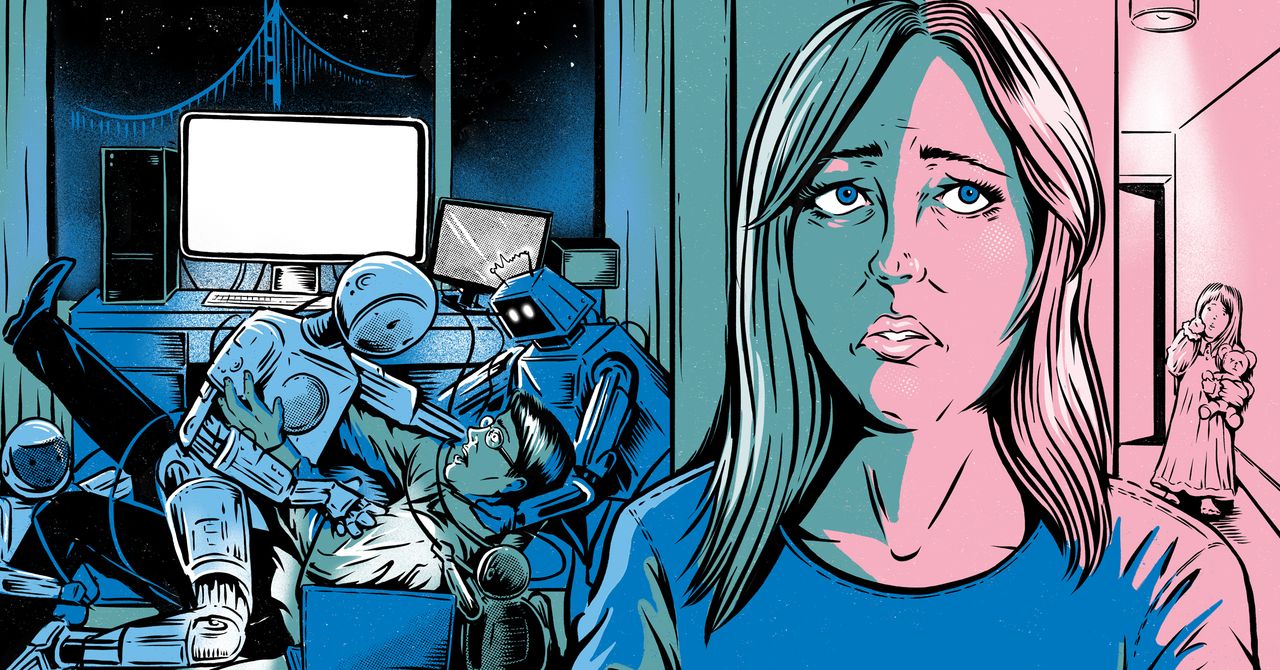
Meet the Sad Wives of AI


Though things keep changing, some analyses suggest that women are about 20 percent less likely than men to use generative AI. “It’s a function not of gender per se,” Rodgers suggests, “but of the occupations that women hold.” Women are disproportionately represented in jobs—education, health care, social services—that right now use AI less. The result could be a compounding disadvantage. Over time, it means less access to the boom’s financial rewards, more responsibility for the domestic labor it generates.And what happens when it doesn’t work out for the men? Many, if not most, won’t make it in AI, a lucrative but volatile business. “With job loss comes some depression,” Rodgers says. “Within the household, if one person is going through adverse mental health effects around job loss or uncertainty, the other naturally becomes the support person.” The cruel irony, for some sad wives, is that the moment their husband does leave AI, whether by choice or by force, there’s no relief. Now he’s home. Spiraling. Now she’s managing that too.It was nearing the end of my therapy session. I had been rambling for 50 minutes about the mental load, the changing hormones, whether my postpartum depression could really just be traced to the fact that it took longer than anticipated to fit back into my jeans. Then my therapist interrupted and asked what exactly my partner did for work again. “Oh,” I said. “Well, he’s head of AI at his company.”What she said next, I had to write down. Her client base, she allowed, is almost entirely women—women whose husbands, more often than not, are in some way professionally adjacent to AI. And it’s affecting their relationships. The pressure to keep up means zero boundaries at home. The very masculine energy of it all. And the constant fighting, which is about something bigger than them. He’s off in another world, a world of prompts and benchmarks and epiphanies, while she’s firmly in this one.The resentment builds quietly. Several of these sad wives, my therapist added, have turned down job opportunities in AI themselves. Not because they weren’t qualified, but because it’s hard to raise kids and disrupt civilization at the same time.Princess Diana famously said there were three people in her marriage. For the sad wives of AI, the third is a chatbot. I spoke to a few other family therapists, and they agreed with mine: The phenomenon is getting worse. “It’s a lot of tech wives,” one said, sighing. “A lot of tech wives.”A tiktok meme has been making the rounds recently: young women at their laptops or doing their makeup, captioned something like, “Working so hard so my man can work on his AI startup that loses $30K a month.” The comments section stands in solidarity: “I’m ded.” “Yas queen.” “Just so he can have ‘founder’ in his bio.” I tried to reach out to some of these women. None bit.I should also say I didn’t bother speaking to any of the actual husbands for this story. I’m sick of hearing from the men of AI. So many of us are. They have podcasts and Senate hearings and magazine profiles and probably a group chat with the president. They’ve been talked to—and I can’t stress this enough—enough.


Source link