DAILY NEWS

Stay Ahead, Stay Informed – Every Day

Advertisement
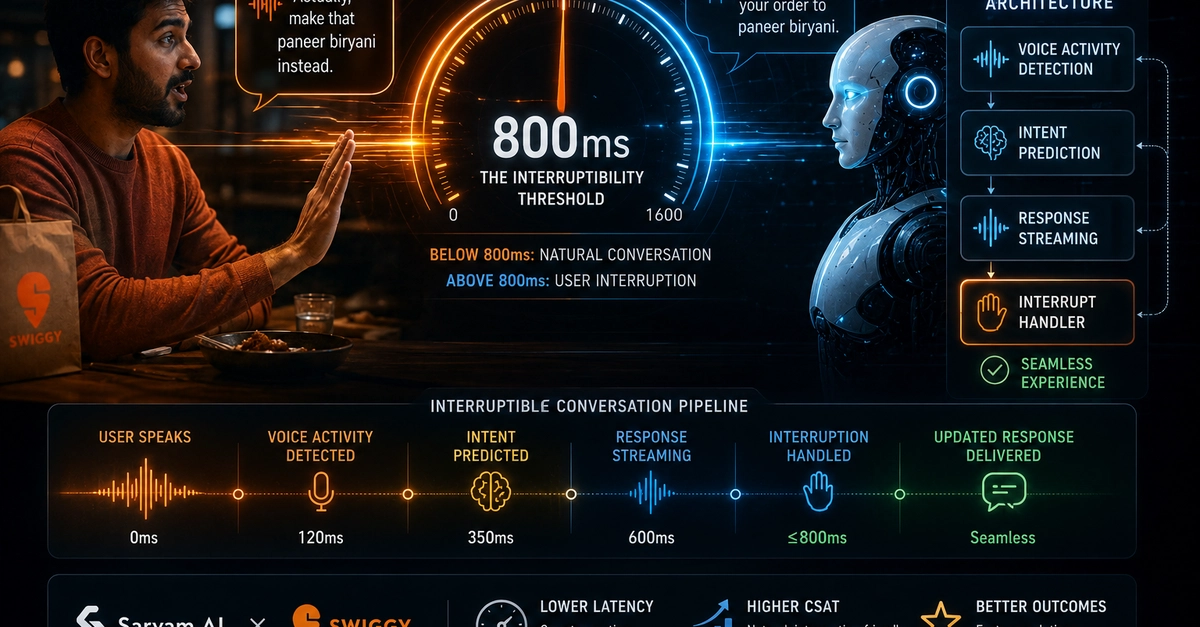
The 800ms Barrier: Architecting Interruptible Voice Agents (Lessons from Sarvam AI x Swiggy)


The 800ms Barrier: Architecting Interruptible Voice Agents (Lessons from Sarvam AI x Swiggy)The Signal: The 800ms Latency BarrierIn a research lab, a 3-second delay is an “optimization ticket.” In a live call with a hungry customer on the Swiggy app, 3 seconds is a churn event.

The partnership between Sarvam AI and Swiggy represents a shift in the “Boss Level” of agentic AI. Most developers build voice agents using a Cascaded Pipeline: STT -> LLM -> TTS. The result? A cumulative lag that makes the agent feel like a slow walkie-talkie. To build for the next billion users, you have to architect for Native Audio Streaming and sub-second response times.

Phase 1: The Architectural BetWe are moving from Request-Response to Streaming State Machines.

The Vendor Trap is relying on general-purpose, text-centric models for a multilingual, audio-first market. If you have to translate “Hinglish” to English just to understand an order, you’ve already lost the latency battle.

The Ownership Path is the Indic-Native Stack. Using Sarvam’s natively trained audio models allows us to process speech-to-intent directly. More importantly, we must implement a Bi-Directional WebSocket architecture. This allows the agent to “listen” while it “speaks”—the only way to handle the most difficult part of human conversation: The Barge-in.

Phase 2: Implementation (The Interruptible Voice Handler)In a high-stakes environment like Swiggy, the agent must be able to stop mid-sentence and roll back its logic if the user changes their mind.

// High-Level Logic for an Interruptible Voice Kernel
class VoiceAgentKernel {
constructor(wsConnection) {
this.ws = wsConnection;
this.isSpeaking = false;
this.transactionLock = null; // Ensuring tool-use safety
}

// Detecting the “Barge-in” (Interruption)
onUserSpeechDetected() {
if (this.isSpeaking) {
console.warn(“SIGNAL: Interruption detected. Executing State Rollback.”);
this.killAudioPlayback();
this.abortCurrentLLMGeneration();
this.clearPendingTransactions();
}
}

async handleAudioStream(chunk) {
// Stream raw audio to Sarvam’s native Indic-pipeline
const response = await this.ws.processAudio(chunk);

if (response.intent_confidence > 0.9) {
// Pre-warm tools before the user even stops talking
this.prepareOrderTransaction(response.entities);
}
}

clearPendingTransactions() {
// Essential: Prevents the “Ghost Order” bug
if (this.transactionLock) {
this.transactionLock.cancel();
this.transactionLock = null;
}
}
}

Enter fullscreen mode

Exit fullscreen mode

Phase 3: The Senior Security & Testing AuditI put this Swiggy-scale blueprint through a professional Senior QA & Security Audit. Here is why your “standard” voice agent will fail in the wild.

The “Ghost Order” Race Condition (Logic Fault)The Fault: The agent says “Ordering your Paneer Tikka…” The user interrupts: “No, wait! Make it a Chicken Roll!”The Audit: In naive implementations, the “Order Tool” is triggered the moment the LLM starts talking. If the user interrupts, the audio stops, but the backend API has already committed the Paneer Tikka. You now have a frustrated customer and a wasted order.The Fix: Implement Deferred Commits. The tool-call must remain in a PENDING state until the audio playback reaches a “Commit Threshold” (e.g., 90% completion) or receives a final verbal confirmation.
The “Ambient Audio Injection” (Security Breach)The Fault: The user is ordering food while walking past a loud TV. The TV says “Cancel all orders.”The Audit: Without Speaker Diarization, the agent cannot distinguish between the primary user and background noise. A malicious or accidental “audio injection” can trigger unauthorized actions.The Fix: Use Sarvam’s front-end audio processing to enforce Voice Activity Detection (VAD) with a noise-floor gate. If the audio signal doesn’t match the primary speaker’s decibel profile or spatial characteristics, the kernel must ignore the intent.
The “Colloquial Logic Bypass” (Semantic Security)The Fault: Your security prompts are in English, but the user is speaking a dialect-heavy mix of Hindi and regional slang.The Audit: Traditional English-centric guardrails often miss the nuance of regional insults or “Hinglish” social engineering attempts used to trick the agent into granting a 100% discount.The Fix: Security filters must be Indic-Native. By using Sarvam’s regional guardrails, we ensure that semantic boundaries are enforced at the phoneme level, not just the translation level.

Phase 4: Checklist (The Architect’s Standard)( ) Native Audio or Bust: If you are still converting audio to text before processing intent, your latency will never hit the 800ms gold standard.

( ) Transactional Barge-in: Verify that every interruption triggers a State Rollback for any pending API calls.

( ) Acoustic Hardening: Test your agent against 60dB of background “street noise” to ensure VAD stability.

( ) Regional Edge-Cases: Audit your “Hinglish” logic. Does your agent understand the difference between a user “asking for a discount” and a user “threatening to cancel”?

The Bottom Line: Building for the next billion users requires an infrastructure that respects the speed of human thought. Sarvam AI provides the native Indic engine; your job is to build the Deterministic House that keeps the order safe.


Source link

ChatGPT Adds ‘Trusted Contact’ Feature to Send Alerts When Conversations Get Dangerous


OpenAI announced today that it’s rolling out a new mental health-focused safety feature for adult ChatGPT users. Starting today, ChatGPT users can add what the company calls a “trusted contact” who may be notified if the AI’s automated systems and trained reviewers determine that the user has engaged in discussions about self-harm. The new feature arrives amid growing scrutiny over the impact AI and other digital platforms can have on mental health. Last year, OpenAI disclosed that 0.07% of its weekly users displayed signs of “mental health emergencies related to psychosis or mania,” while 0.15% expressed risk of “self-harm or suicide,” and another 0.15% showed signs of “emotional reliance on AI.” Considering the company claims that roughly 10% of the world’s population uses ChatGPT weekly, that could amount to nearly three million people. The trusted contact feature expands on ChatGPT’s existing parental safety notifications, which alert parents when a linked teen account shows signs of distress. Instagram introduced similar parental alerts earlier this year. Now, OpenAI is offering these alerts to its adult users. The company said the feature was developed with guidance from mental health and suicide prevention clinicians, researchers, and organizations. “Trusted Contact⁠ is designed to encourage connection with someone the user already trusts,” the company said in its announcement. “It does not replace professional care or crisis services, and is one of several layers of safeguards to support people in distress.” OpenAI added that ChatGPT will still encourage users to contact crisis hotlines or emergency services when necessary. The feature can be enabled by any user 18 years or older through ChatGPT’s settings. From there, users can nominate another adult to serve as their trusted contact by submitting details such as the contact’s phone number and email address. The trusted contact will then receive an invitation explaining the feature and will have one week to accept. If they decline, the initial user can nominate another contact instead. Once the feature is active, OpenAI’s automated monitoring systems can flag when a user may be discussing self-harm in a manner that suggests a serious safety concern. The system will then notify the user that their trusted contact may be alerted and encourage them to reach out directly. It will even provide some recommended conversation starters. The company said a small team of specially trained reviewers will then assess the situation and determine whether notifying the trusted contact is appropriate. If OpenAI decides to send an alert, the trusted contact could receive it through email, text message, or an in-app notification. The alert will only explain the general reason self-harm was mentioned and encourage the trusted contact to check in. It will also include guidance on how to navigate those conversations. OpenAI noted that the notifications will not include specific details or chat transcripts to protect user privacy.


Source link

Google DeepMind Gets Into Gaming, Purchases Stake in the Company Behind EVE Online


AI companies have long used video games to train and test their models, so it’s not a huge surprise that Google DeepMind has now acquired a minority stake in the maker of the popular MMORPG EVE Online. The partnership comes as the studio behind EVE Online announced that it is becoming independent again. Fernris Creations, formerly known as CCP Games, said that it has bought itself back from Korean video game company Pearl Abyss in a deal worth $120 million. EVE Online first launched in 2003 and is known for its sprawling open-world universe, where players can explore more than 7,000 star systems and participate in various in-game activities like mining, piracy, trading, combat, and even politics. 

Alongside the buyout announcement, the company also revealed a new research partnership with Google DeepMind, in which the AI lab has taken a minority stake in Fernris Creations. “As part of this next chapter, we are beginning a research partnership with Google DeepMind, focused on intelligence in complex, dynamic, player-driven systems. This is something I am genuinely excited about,” Fernris Creations CEO Hilmar Veigar Pétursson wrote in a blog post announcing the partnership.

According to a press release, the collaboration will focus on improving the “understanding of intelligence in complex, dynamic systems” and explore areas such as long-horizon planning, memory, and continual learning. In practice, Google DeepMind will test and evaluate AI models on an offline version of EVE Online running on a local server. The companies also said they plan to explore AI-powered gameplay experiences.

“I’ve known Hilmar for many years and long admired his work, and I’m thrilled to partner with him and the fantastic team at Fenris Creations to explore new gaming experiences and advance AI research safely inside a player-driven universe as amazingly complex as EVE Online,” Google DeepMind CEO and co-founder Demis Hassabis said in the press release. Hassabis added that video games are the “perfect training ground for developing and testing AI algorithms.” He pointed to some of the lab’s previous breakthroughs, including AlphaGo defeating world champion Lee Sedol in 2016 and AlphaStar reaching “Grandmaster” level in StarCraft II in 2019.

Other AI companies have pulled off similar feats. In 2019, an AI built by OpenAI defeated world champions in Defense of the Ancients 2, better known as Dota 2. OpenAI’s success with Dota 2 has even resurfaced this week during Elon Musk’s ongoing legal battle with OpenAI and CEO Sam Altman.  The New York Times reports that after OpenAI President Greg Brockman emailed Musk to inform him that the company’s AI had won an international Dota tournament, Musk replied: “Time to make the next step for OpenAI. This is the triggering event.”


Source link